copyright © 2012-2026
www.akupintar.info
all rights reserved
Palm Trees Montessori School
Sekolah KB,TK,SD
Jl. Pesantren no.35. RT002/RW001 Kel. Jelupang. Kec. Serpong Utara
Tangerang
Banten
https://www.akupintar.info/photo/logo_1359510839_logo.gif
(021) 53153658 & 70600559
http://www.palmtreesmontessori.com

Rating : -

Silakan Login untuk memberikan Rating
Palm Trees Montessori School

|
||
| Jenjang | : | KB,TK,SD |
| Alamat | : | Jl. Pesantren no.35. RT002/RW001 Kel. Jelupang. Kec. Serpong Utara Tangerang, 15323 Banten |
| Telepon | : | (021) 53153658 & 70600559 |
| : | info@palmtreesmontessori.com | |
| Website | : | www.palmtreesmontessori.com |
| Biaya Bulanan | : | > Rp 1.000.000 |


Setiap orangtua ingin memberikan pendidikan yang terbaik bagi anaknya. Dengan semakin banyaknya sekolah yang bermunculan, memilih sekolah menjadi pekerjaan semakin rumit bagi orangtua. Semakin banyak pilihan, orangtua semakin bingung memilih. Ada beberapa point penting yang bisa menolong para orangtua dalam menentukan pilihan yang paling tepat bagi anaknya.
1. KEYAKINAN. Yakinlah ...

Banyak orangtua tidak memiliki banyak waktu untuk dapat berkunjung ke sekolah-sekolah saat akan memilih sekolah yang paling tepat untuk anaknya. Jika Anda adalah orangtua yang sibuk, pergunakan daftar pertanyaan berikut untuk menanyakan hal-hal terpenting yang Anda perlu ketahui sebelum akhirnya Anda memilih sekolah mana yang akan Anda coba.
Kelas apa saja ...
Tentang Lembaga
Kurikulum
Program & Prestasi
Fasilitas
Biaya
Foto
Coba Gratis
Review
Tentang Lembaga
|
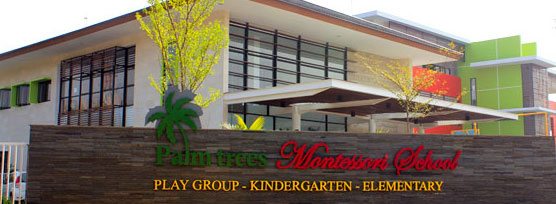
Palm Trees Montessori School is a private school for children ages 1.5 to 12 years, Pre-school through Grade 6. The school was established in 2000, and owned by PT. Citra Anak Mandiri. |
Kurikulum
 |
The Montessori Method includes the use of a wide range of specially designed teaching materials which form part of prepared environment, to enable children to learn individually, at their own pace, in a non-competitive atmosphere. |
|
Major Point of Montessori Method
|
Program & Prestasi
PRESCHOOL CURRICULUM
Practical Life
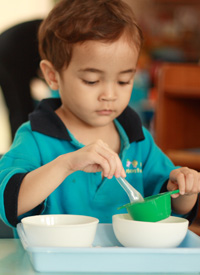 |
The very first activities children take part in a Montessori classroom develop their ability to look after themselves and their surroundings. They can practice dressing skills on specially made frames, which allow them to try zips, buttons, bows and buckles. They use little jugs filled with beans or rice and then water to practice pouring; they spoon, scoop, or use droppers and even tweezers to transfer from one bowl to another.
|
Sensorial
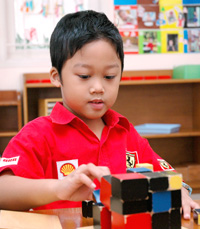 |
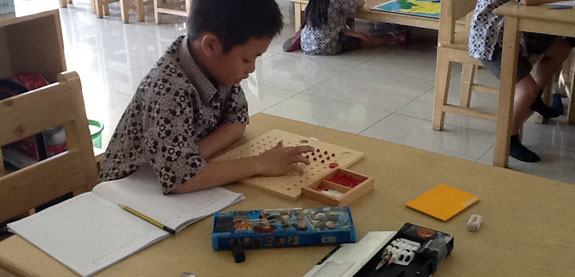
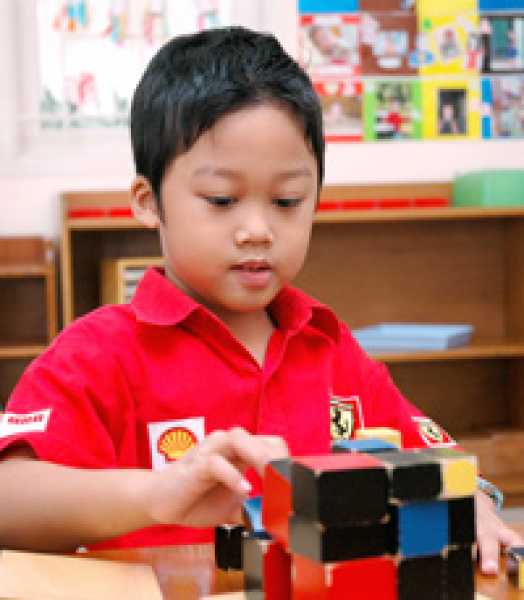
On the Sensorial shelves there will be specially designed materials to encourage development of the senses, such as a tower of pink blocks; sets of cylinders gradated in size; cylinders with knobs which have to be fitted into the right holes in a block; rough and smooth tablets in boxes; smelling bottles; fabrics to sort by touch; puzzle blocks called the binomial and trinomial cubes which are interesting in themselves but later turn out to be a physical illustration of mathematical formulae. Each of these is used to stimulate and refine one of the ten sensory areas and each will be presented to the child to be used in an exact way to aid his development. The sensorial materials also prepare the child for reading and writing.
|
Cultural
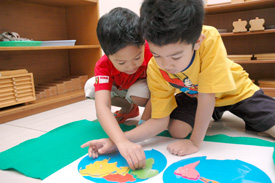 |
Children begin with globes and then study maps using jigsaws. They can trace and color the shapes of each continent as well as placing them in the right place in the puzzle. They go on to name and put the shapes onto blank maps of the world and to recognize flags. Looking at countries individually they will use picture cards of mothers and babies, families and their daily lives and handle and examine artifacts from other cultures. We have cultural boxes, one for each country, filled with all the exotica teachers can find to bring new places alive. On festival day's schools may celebrate with tastes of exotic foods, learn songs from other countries, costume and celebrations. |
Language
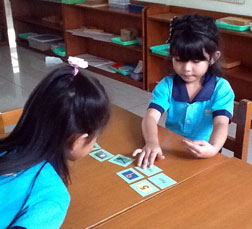 |
Writing often comes before reading in a Montessori classroom with children building up their first words phonetically using cardboard letters.
|
Social Skill
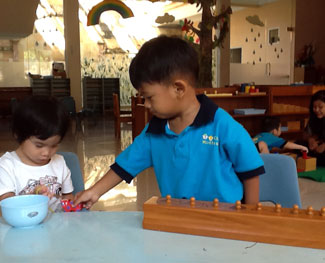 |
Children aren't born with an innate knowledge of why we shake hands, or kiss, depending on our culture and in the Montessori classroom they learn appropriate greetings. As they become aware of other cultures they are encouraged to celebrate differences and value them equally. During circle time children are shown how to move quietly and carefully around the classroom, push in chairs, wait patiently before politely gaining someone's attention and are reminded how important it is to allow others to work undisturbed. These ground rules in the classroom give every child total security. Children also learn to notice if somebody needs help nod that nobody is too small to be useful.
|
Math
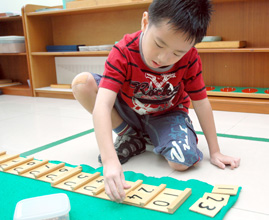 |
Children must have a multitude of sensorial experiences with size, dimension and form before they are introduced to mathematical quantities and their symbols. Before formal lessons, the children need casual practice with rod counting. Once they are certain of quantity and symbol of numbers 0 through 10, an overview of the base 10 system with numbers 0 - 9999 is begun. Next in the sequence comes counting the squares and cubes of sets of numbers 1 through 10. Simultaneously, children are taught simple one-digit, concrete, static addition and subtraction. Once the children can skip-count from memory, multiplication is introduced and is followed by division with no remainders.
|
Fasilitas
Data belum lengkap.
Untuk Anda pengelola, silakan login lembaga untuk melengkapi profil dari usaha AndaBiaya
Data belum lengkap.
Untuk Anda pengelola, silakan login lembaga untuk melengkapi profil dari usaha AndaFoto




Coba Gratis
For registration only.
Review Lembaga
Kirim Review
Silakan login untuk mengirimkan review.
Sekolah Lain
di Area yang Sama

Kompl Griya Asri
Kompl Griya Asri Bl D/61-A
Jelupang, Serpong
Villa Melati Mas
Villa Melati Mas Bl F
Jelupang, Serpong

Regensi Melati Mas Blok B14 Serpong Utara
 KEMBALI